Research review Automation Score 88
Make Review for Automation Buyers
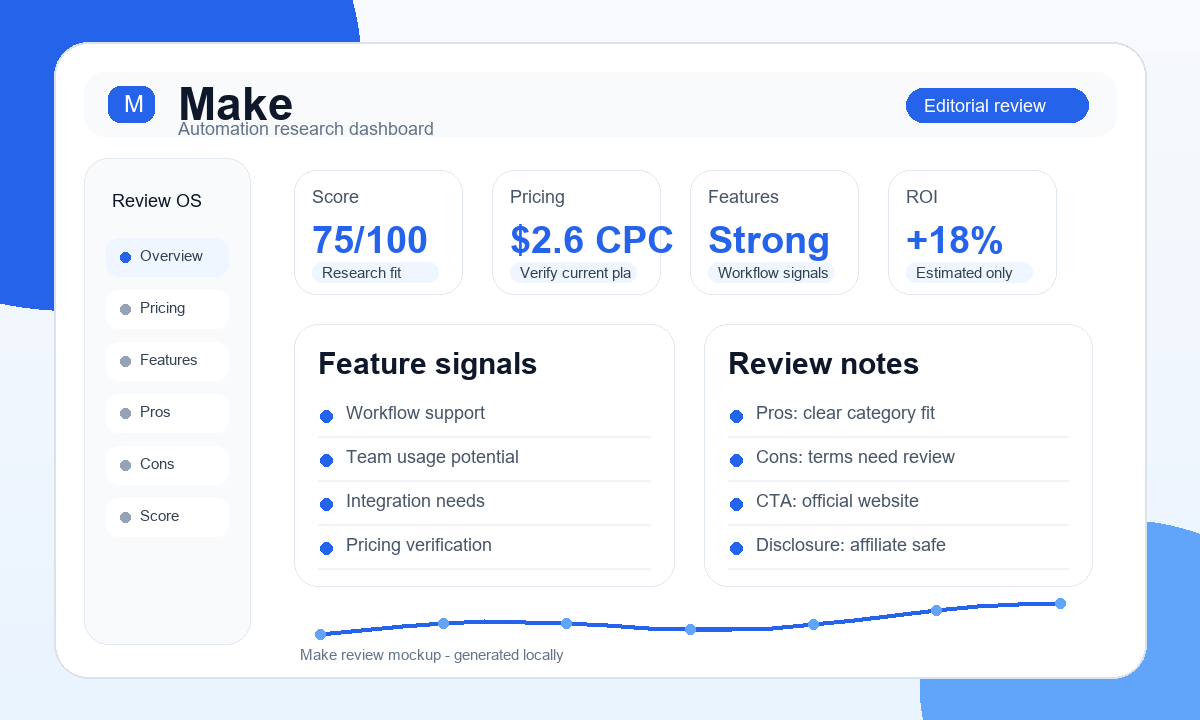
Automation tools are best judged by how reliably they connect real processes, not by the number of app logos on a homepage. This Make review is written for readers who want a practical decision page before they click through to the official website. The focus is not hype; it is whether Make fits a real workflow, what should be verified, and which alternatives deserve a look.
Editorial score: 88 | Risk level: Low | Trend: Rising
Pricing summary: verify current plan limits, usage caps, team seats, cancellation terms, and official pricing before buying or promoting Make.
Visit Official WebsiteCheck current pricing
CTA status: Official site / affiliate pending when no approved affiliate URL is available.
Affiliate disclosure
Some links may be affiliate links. We may earn a commission at no extra cost to you. Reviews and comparisons are research-style content, not guaranteed results.
Quick verdict
Make is worth shortlisting if your Automation workflow needs automation workflows that save repeated effort without creating fragile processes nobody can maintain. It should still be checked against current pricing, plan limits, support expectations, and affiliate policy before any serious purchase or promotion.
Score signal
88. Treat this as an editorial research score, not proof that the tool will fit every buyer.
Risk signal
Low. The main risk is usually policy, pricing, or workflow mismatch rather than the brand name itself.
Market signal
Medium competition. Comparison and review pages are usually safer than broad claims.
Overview
Make sits in the Automation category, so the review lens is workflow fit rather than hype. In this category, the practical question is whether the tool can support connecting apps, moving data, triggering actions, and reducing repeated manual operations without adding a new layer of manual cleanup.
The market around this type of software can be noisy. Some readers compare tools because they want a faster workflow, while others are checking pricing, alternatives, or whether the product is suitable for a team. This page keeps those questions separate so the decision does not come from a single feature list.
Current research signals show competition as Medium. That means a direct paid traffic test should be handled carefully, and organic pages should include comparison context, honest limitations, and a clear disclosure. Recommended discovery channels for this tool category include Google Search, Bing Search, LinkedIn.
A useful review of Make should therefore answer three buyer questions: what job the product is likely to help with, what kind of user should avoid it, and what proof still needs to come from the official website before money or traffic is committed.
Best for / Not best for
Best for
- Operators connecting SaaS tools.
- Small teams reducing repeated admin work.
- Builders who can document and test workflows.
Not best for
- One-off tasks that do not repeat.
- Teams without clear process ownership.
- Workflows requiring unsupported private systems.
Make is most relevant for readers who already know they need help in the Automation workflow and want to compare a focused tool against broader alternatives. It may be the wrong choice if the use case is vague, if the team cannot verify integrations, or if the buying decision depends on a feature that is not confirmed by the vendor.
Feature checklist
Use this checklist as a structured way to evaluate Make. It is not a substitute for official documentation, but it helps separate a useful product fit from a tool that merely looks good on a landing page.
| Area to check | Why it matters | Buyer action |
|---|---|---|
| App connectors | The tool must support the apps in your workflow. | Confirm exact triggers and actions. |
| Error handling | Broken automations can silently lose data. | Check logs and retry behavior. |
| Scenario design | Complex flows need visual clarity. | Map the workflow before buying. |
Best use cases
The strongest reason to research Make is not that it belongs to a popular category. It is that a buyer may have a repeated task in Automation where a structured tool can reduce manual work, improve consistency, or make collaboration easier to manage.
A practical example is a small team routing lead data from a form into a CRM, sending a notification, and logging the action for follow-up. In that kind of workflow, the value comes from repeatability: the same process can be run again, reviewed by another person, and improved when results are weak.
Workflow setup
Use the tool when you need a repeatable workflow that can be documented, reviewed, and improved over time.
Team comparison
Compare it with alternatives when several team members need to understand tradeoffs before choosing a platform.
Affiliate research
Use review-style content when direct linking or trademark bidding is unclear and a safer disclosure page is needed.
For paid traffic or affiliate promotion, the safer route is to start with review and comparison keywords. Avoid implying guaranteed outcomes, fixed savings, or current pricing unless those details were verified directly from the vendor at the time of publishing.
Pros and cons
| Pros | Cons |
|---|---|
| + Good fit for repeated workflows where manual copying or status updates waste time. | - Can create hidden maintenance work if automations are built without documentation. |
| + Can support comparison and review content without exaggerated claims. | - Not every traffic source or direct-linking method may be allowed. |
| + Useful for building a practical shortlist with alternatives. | - Real value depends on the user's process, team size, and integrations. |
For Make, the main advantage is that it gives buyers a concrete product to evaluate instead of a vague category search. The main limitation is that public research alone is not enough for final buying or promotion decisions. Always confirm terms, plan limits, current pricing, cancellation rules, and allowed promotional methods.
Real buying considerations
Before treating Make as the right Automation choice, slow down and check the operational details that rarely fit into a short product summary. The biggest mistakes usually happen when a buyer assumes a feature is included, a traffic source is allowed, or a team workflow will transfer cleanly from another product.
- Workflow proof: write down the exact process you expect Make to improve, then check whether the product supports each step.
- Team fit: confirm seats, permissions, sharing, and collaboration limits if more than one person will use it.
- Policy fit: for affiliate or paid traffic work, confirm PPC, brand bidding, direct linking, coupon rules, and disclosure requirements.
- Exit risk: understand export options, cancellation rules, and how hard it would be to move to another tool later.
This review intentionally avoids guaranteed outcomes. A tool can be strong in public research and still be wrong for a particular team, budget, country, or traffic strategy.
Pricing note
Pricing can change, and this page does not treat any plan, discount, or payout as permanent. Before buying Make, check the official pricing page for plan limits, included seats, usage caps, cancellation rules, trial terms, and whether the features you need are available on the plan you are considering.
If you are researching the product as an affiliate, also check the affiliate program terms separately. A product can be attractive for buyers while still having restrictions around PPC, coupon keywords, brand bidding, direct linking, or country eligibility.
Alternatives
Make should be compared against alternatives before a serious purchase or promotion decision. Alternatives help reveal whether the product is priced fairly for your workflow, whether a simpler tool would be enough, and whether a different category solves the same problem with less operational friction.
- Zapier for another Automation workflow angle.
- ActiveCampaign for another Email Marketing workflow angle.
- AdCreative AI for another Marketing workflow angle.
- Canva for another AI Design workflow angle.
- Copy.ai for another AI Writing workflow angle.
When comparing alternatives, avoid treating a higher score as automatic proof. Look at workflow fit, policy clarity, integrations, support expectations, cancellation terms, and whether the product solves the specific job that led you to search in the first place.
Final recommendation
Make is worth researching when the use case is clear and the buyer understands what must be verified on the official website. It is not a tool to promote with exaggerated promises, fixed income claims, or outdated pricing details. The safer approach is to use this review as a screening page, then check the vendor's latest terms before any purchase or campaign.
For affiliate work, the current risk level is Low. That does not mean the offer is automatically unsafe. It means the page should keep disclosure visible, send outbound clicks through tracking, and avoid claims that cannot be supported by current vendor information.
Shortlist it when the workflow is repeated often enough to justify setup, testing, and monitoring.
Recommended next step: compare Make with at least two alternatives, verify current pricing, and document the policy notes before using paid traffic or recommending it to a specific audience.
Next step
If Make still looks relevant after this review, visit the official website through the tracking link below and verify the latest product details yourself. The link may route to an approved affiliate URL when available; otherwise it uses the Official site / affiliate pending destination.
FAQ
Is Make beginner-friendly?
Pricing, plans, integrations and terms can change. Verify details on the official vendor website before buying or promoting this tool.
How should I check Make pricing?
Pricing, plans, integrations and terms can change. Verify details on the official vendor website before buying or promoting this tool.
What are the best alternatives to Make?
Pricing, plans, integrations and terms can change. Verify details on the official vendor website before buying or promoting this tool.
Can teams use Make?
Pricing, plans, integrations and terms can change. Verify details on the official vendor website before buying or promoting this tool.
Does Make support integrations?
Pricing, plans, integrations and terms can change. Verify details on the official vendor website before buying or promoting this tool.
What should I verify before promoting Make as an affiliate?
Pricing, plans, integrations and terms can change. Verify details on the official vendor website before buying or promoting this tool.